Saturday, November 11, 2017
More Text Addiction
So I ran across Dennis LeHane’s latest in the new book shelf at the Atlanta Ponce library. His Mystic River was first rate – so says James Lee Burke. But he wrote one where I felt so suckered I vowed not to read him again. But this one drew me in, thought I’d give it a chance. The first hundred pages read like a book club book: serious, smart writing, psychologically insightful, lot of research to make the world he’s portraying credible. A young woman grows up with an intense single Mom and, losing her in an accident, seeks out her biological father, even hiring a private detective who later becomes a major character in the story. The book suddenly becomes crime fiction, a mystery that keeps you befuddled, careening from event to event, from mental breakdown to recovery and back again in a very dark world. A good read but with one or two credibility flaws you’ll have to overlook if you want, at that point, which you will, to finish.
I’ve encountered the respectable political writer Matt Taibbi inRolling Stone Magazine and ran across his book I Can’t Breathe: A Killing on Bay Street about Eric Garner, the 2014 fatal victim of police brutality in the Bronx. I wondered, how do you write a whole book about one street killing? Taibbi uses it as a means to explore the dynamic of police departments, prosecutors, judges, politicians, and the varied people they’re supposed to be serving. This was definitely Matt’s focus, sympathetically portraying the victims of racism and poverty, and not so sympathetically sketching the police perpetrators, demonstrating racism at all levels of the bureaucracy and its poisonous effect, both in elevating white fear of dark people and perpetuating it with their draconian tactics. He covers the phenomenon called “Broken Windows,” a police strategy based on the theory that aggressively attacking minor crime will reduce total crime. Not quite buying it, Matt describes it as a belief that if you go after graffiti vandals the murder rate will somehow drop. He cites an incident in 1971 Arkansas where a cop shot a black man between the eyes for the crime of requesting a receipt for a traffic fine. The cop was of course acquitted. This he ties in with the killing of Eric Garner and the police coverup (a little more difficult than usual since it was video-taped) and prosecutorial grand jury manipulation leading to no indictment. The cop who did the killing had a long history of citizen complaints and a police department/bureaucracy that seemed willing to dismiss any and all charges. Not a book with a happy ending unless you identify with villains – the prosecutor goes merrily on to a successful run for congress, the officer goes unimpeded on his violent trail to a nice retirement. Maybe karma will take care of it all, the justice system certainly didn’t.
In Kansas, 150 years earlier, the same ignorance and casual violence was at work, though, as portrayed in Tom Clavin’s book, Dodge City, there was significant, and somewhat successful, resistance in the form of Wyatt Earp, Bat Masterson, their brothers and friends. The “good guys” weren’t exactly choir boys as the saying goes, but they had an integrity, at least in Clavin’s coverage, not evident in Taibbi’s book. They were surrounded by corrupt lawmen, politicians, cattlemen, reckless cowboys and vicious sociopathic outlaws differentiated from today’s mobsters only by horses instead of Lincoln Town Cars. Women fit into the story only peripherally, mostly as prostitutes. “Taming the west” involved colossal injustice for natives: the stealing of their land; forced removal to “reservations”, often the least habitable areas around, which were stolen again whenever precious metals were discovered; the wanton slaughter of the magnificent buffalo to near-extinction, on which the natives were dependent for food. The “good guys” Wyatt and Bat did little on this illegal front, standing on the wrong side of it in fact as their early work was killing buffalo for the hides, well, the money for the hides – ain’t it always so. Daniel Quinn, in the novel Ishmael, asks the reader to – Imagine yourself in 1930s Germany; what would you do? Extending the question to the western United States in 1870, or hell, to our 2017 world, points up the immense difficulty confronting those who would intervene in the relentless trajectory of rapacious patriarchal greed.
That brings us to another book I’ve been dipping into, Eckhart Tolle’s, The Power of Now, the book that brought him fame. It provides the hope lacking in these other books. In the form of questions from Tolle’s clients and his answers, it covers basically the same ground as his wonderful A New Earth (I like to say, the most important book ever published). In a nutshell, the hope consists in realizing that human dysfunction, at the root of all that ails our civilization… greed, conflict, war… is a mental construct he calls ego. Even the reformers, the activists who dream of and work for peace are often captured by it. The ultimate form of activism is to become the observer, of the thoughts and emotions, the mind chatter, that drifts across our field of awareness, observing rather than being them, avoiding mistaking them for us. Our real selves, in essence, is that observer which is consciousness. Bringing the light of consciousness to those thoughts and emotions, they are transposed into presence. In presence is joy of being and eventually comes an impulse to creativity, an ego-less act aligned with the intelligence, the source of being. We don’t decide to be good, to act according to some ethical creed, we get present and our behavior, aligned as said, is ethical, sensitive, caring, compassionate and respectful of the miracle of life, recognizing that the essence, consciousness, is where we all meet. I did say, “in a nutshell” – Tolle’s books and talks elaborate on these appealing ideas which are newly articulated but hardly original, having been stated, and mostly misunderstood, in many, often esoteric, forms, by rare and singular individuals throughout history.
Monday, October 23, 2017
Meandering Mind Stream
Caught without my emergency notebooks, not even a book, I found myself with 45 minutes to kill before the East Atlanta library opened. Fortunately Joe's Coffee Shop is nearby. Browsing their little book shelf I found a John Le Carre novel. With coffee I read ten or fifteen pages, marveling at his superb writing. Coincidentally the hold books I was there to pick up included a Le Carre memoir, a collection of magazine articles he published over the years, a unique form of memoir. In his 80s now, Le Carre reflects on a long life of unusual good luck and the usual share of heartache. Since writing spy novels played a way important part of his life, he refers often to trips he made for research or events that triggered certain novels or episodes. I've read all of his books, I think, except The Night Manager, which I somehow missed. Oh, and The Little Drummer Girl, which I quit, finding its glorification of the Israeli Mosaad a bit much. I may have been wrong on this because the author's politics seem to be generally respectable. Reading the memoir made me want to go back and re-read his whole catalog, a luxury I really don't think I can indulge, given the list of books I haven't gotten to yet.
The other hold book was Norman Mailer's, Armies of the Night. This latter I came to by a reference in Noam Chomsky's American Power, where he mentioned the weekend he spent in Jail, arrested with Mailer and others in a demonstration at the Pentagon. Armies of the Night is Mailer's playful account of that weekend. It's told whimsically in the third person narrative with Mailer as the central character. The writer can hardly form a sentence without revealing a broad erudition and a great confidence in his opinons and theories of human behavior, and an anthropomorphizing of America (north not south). He calls himself a conservative leftist without quite defining that and describes his fellow inmates with sometimes derision and sometimes great respect. He's sort of all over the place but fun, anyway, to witness a nimble and mind at work (or play). He makes fun of himself and his 4 marriages and multiple children and maverick reputation, using just that removed narrative to do it. He ruminates, naturally, on the Vietnam War, the reason for the demonstration, savagely attacking U.S. coporations and hysteria around communism. Critiquing the Right's justification for their war (basically the domino theory), and caricaturing a bit the “liberal” opposition, he remains vague as compared to Chomsky's persuasive take in American Power where the motivation is laid out clearly: the ruling class reflexibly strikes out at any organized resistance or alternative to capitalism, the system that provides them with their ultra privileged lives.
Just a mile or two southeast of where I live, lies a neighborhood bordering Grant Park, the setting for another book I was working on, The Big Bust at Tyronne's Boarding House by James Gallant. The casually humorous, autobiographical-seeming story is of a writer, a stay-at-home scribe who is constantly distracted from his calling by his own lack of focus and an array of neighborhood characters ranging from prostitutes to eccentric elders, an ex-green beret buddy and crack dealers. The time frame is probably the 80s when that neighborhood was just beginning its gentrification transformation. The characters rob him of his time and money with their constant visiting and borrowing. His laid back openess to them is touching even as he uses them in his stories, even paying some for their stories. I picked up the book free somewhere. It has an attached note – This book is free – enjoy! If you should be overwhelmed by an urge to remunerate the author, who is not a wealthy man, he will not object to receiving checks in any amount - Such quality writing reminds me of one of my favorite bands, The Swimming Pool Qs. Their falling just short of the combination of luck and connection, but not talent, to break into the big money, though unfortunate for them, makes it possible for a low-income person like myself to go see 'em. But things are looking up a little - Vagabondage Press is publishing Gallant's Whatever Happened to Ohio? It will be an e-book initially, distributed by Amazon, Barnes and Noble, etc., probably selling for about $4. - his website: www.jamesgallantwriter.com
Also in East Atlanta - The Longest US War: Korea 1950 – 2017, a presentation by Ajamu Baraka October 17 First Iconium Baptist Church: Ajamu Baraka ran on the Jill Stein Green Party ticket, spoilers some might say. My position was that Trump or Hillary, one of 'em, was going to be president. Progressives would be fighting Hillary's hawkish foreign policy. She was good more or less on some issues, race and women but an establishment figure solidly in bed with the 1%. But as compared to Trump? No contest. Subsequent events have certainly confirmed this choice – I mean, Jeff Sessions Attorney General? Pruit at EPA? Loony Tunes is far too mild a description. My first thought that awful Wednesday morning was, “We've decided, as a species, on suicide.” Later I heard Bernie's reality check, “We have no right to quit. The stakes are too high.”
But I'm not going to blame the Green Party, entirely, plenty of other factors figure in. Ajamu's talk after all was about Korea. He used incendiary words (they're incendiary because of the propaganda efforts of the 1%) like U.S. Imperialism and hegemony. He questioned the official narrative which portrays the U.S. in benevolent terms and demonizes the official enemy and attempted to humanize the situation, to acknowledge the Korean people as living persons not communists. And he emphasized that the U.S. has no right to determine what kind of society North Korea has. Even if the U.S. were sincere, not hypocritical in its criticism, the way to peace is not war. It is rather arrived at through the skills of non-violent conflict resolution. It must have been disappointing for the speaker and organizers, that despite the bellicose rhetoric coming out of both captials, there was a very light turn out for the event.
The light turn-out made it feasible for me to get to the speaker and ask about I.F. Stone's book, The Hidden History of the Korean War. The speaker was aware of it but hadn't read it. Stone was blacklisted in the late 40s – 50s, so started a weekly newsletter, which sustained him during this bleak history. The facts in his book on Korea, so he could not be accused of treason, came entirely from the congressional record. Salient items: the U.S. straffed North Korean vehicles carrying delegates to the peace talks and, at the talks, offered proposals designed to be rejected. “We” were winning, why seek peace? The Soviet Union however gave mig jets to China (which came into the war thanks to McCarthur's foolish aggression). These migs could shoot down B-29 bombers which had given an edge to the U.S. Without this edge, suddenly the U.S. was interested in peace and the armistice was finally reached, which has held precariously since.
I've been dipping, for this writing, into the books that litter my sofa and kitchen table. Re-reading Eckhart Tolle's, Power of Now, the first book of his I read and an amazing work. It offers an analysis of what is at the root of all these problems I'm complaining about, which reduces to ego, the dysfunction of our culture which we either root out or perish. Tolle doesn't say anything that hasn't been said before but no one, to my awareness, has said it with such consistency and clarity. Even Oprah agrees with me on this calling his work the most important reading she's encountered.
Another on the stack, from the library, Al Gore's sequel to An Inconvenient Truth – Truth to Power Al initiated a satellite project as vice-president to monitor climate change and provide solar disruption warnings. It was cancelled by the Bush/Cheney administration. When businesses complained because the disruption warnings would be important in protecting their electric systems, Bush proposed replacing the climate monitoring aspect with sand bags. Gore remarked, “That is real extremism.” The project was side-lined and finally accomplished under Obama.
Patricia Highsmith, wrote a short story in 1955, The Talented Mr. Ripley, followed in the 70s by Ripley Underground and Ripley's Game. Matt Damon played Ripley in the film of the first. I had been reading a streak of Martha Grimes crime fiction and got tired of her. Usually when I find a new author I greedily read everything they've written and am eagerly waiting the next new one, or mourning if the author is no longer writing. Grimes however wore me out with her productivity. I happened on a list of women novelists on line, Highsmith among them. Learning that she wrote the follow up Ripley books led me to put a hold on one that had all three. Odd to find oneself rooting for a murderer, worried as the police close in, relieved when he talks his way out. The third one is starting to portray him in a less sympathetic way and I suspect she's going to finally bust him. Nope. Though it's her last book on that character there was room for sequel. Later, Donald Westlake writing as Richard Stark, took up the practice of anti-hero in his nobel criminal Parker. Then Lawrence Block did his hit-man series.
My text addiction is serious, though late in starting. I was in my early 20s before I discovered the world of intellect and I've been trying to make up for those lost years ever since. As things are winding down now I have to question whether this is the best use of my time. Shouldn't I perhaps be spending what I allocate to books (and writing for that matter) to attempt to intervene in our headlong rush toward extinction? A fair question. I'll have to get back to you on that.
Tuesday, October 3, 2017
Vietnam in the Air
Timely to have happened on the book, Hue 1968 by Mark Bowden, at the library just as the Ken Burns' Vietnam: A Television History began on PBS. I was curious to see what perspective was brought to both the book and documentary. The factoid that especially interested me: Vietnam was one country, temporarily divided by the Geneva Accords, after the French defeat at Dien Bien Phu. Elections were to be held in 1956 to unify the country (which I repeat... was one country). When it became evident that Ho Chi Minh would easily win, the U.S. colluded with the temporary caretaker government to boycott the elections. Thus was created South Vietnam. Thus was democracy scuttled.
Wiping away the cobwebs of self deceipt and propaganda, a government with democratic pretensions but oligarchic realities dismisses the will of the people when it threatens their rule. They annoint and militarily back a tyrannical government in the south that mirrors their own, an elite interested only in their own privilege and power. Even the writer of this quite critical book (author of the highly successful Blackhawk Downs) falls victim sometimes to the propaganda. He fails, I think, to properly highlight this incredibly important subterfuge, the disastrous canceling of elections that would have very likely, entirely avoided the death and misery to come. This should have been repeated, maybe run at the bottom screen continually in the TV History, like those CNN ticker tape reports. And in one sentence he refers to the “communist” versus the “free” forces, when in fact there was nothing “free” about the southern situation except the usual feudalism, freedom to chase money. Vietcong, Buddhists and other opposition groups were excluded from participation in elections and repressed in their activism. One of democracy's chief purposes and benefits is the peaceful transfer of power, the avoidance of war, with its inglorious cost. Yet we were told our troops were fighting for freedom and democracy. Well, obviously they couldn't have said,“We want you to kill, die, sacrifice and suffer so the elite can continue to enjoy its great privileged life style.” Who would have supported that project? Yet that is exactly what it was about.
Bowden does not spare the facts. He refers to the trail of deception revealed by The Pentagon Papers but emphasizes the military stupidity, on both sides, that led to the terrible loss of life at Hue during the 1968 Tet Offensive, particularly the civilian carnage. He seems, at times, to set aside his knowledge of the decision to thwart democracy as when he proclaims that the U.S. had every right to choose sides in what he calls the Saigon/Hanoi struggle. In the Ken Burns film there is a similar forgetfulness. North Vietnam is repeatedly referred to as “Communist Vietnam” but the south is never referred to as “Capitalist Vietnam”. Whether this is conscious propaganda or simply embedded in the psyche, it is hardly objective. I've noticed this in other documentaries, where scary, goose-stepping, bayonet wielding hoards appear just when the narrator intones the word, communism - classic Skinnerian conditioning. In a sense the U.S. purpose was freedom and democracy. The ideologue attempts, in that pairing, to capture the prestige of the word democracy and indelibly associate it with capitalism, what they really mean by “freedom”. One of the things that struck me in an interview with Ken Burns and Lynn Novick on Terry Gross' Fresh Air was Burns' statement that a high percentage of the public felt that the students killed at Kent State University anti-war demonstrations “got what they deserved”. This is a measure of the disheartening success of propaganda and, though Trump is no doubt a bit of a loose cannon in establishment eyes, his election is another.
There is a scene in Burn's film where John Foster Dulles is said to make the decision to support Diem's refusal to honor the elections. It is presented as an agonizing decision yet the Secretary of State, and his CIA Chief brother Allen, were known to be hysterically anti-communist religious fundamentalists. Their objection to communism lay not in its authoritarianism but in its disdain for religion and rejection of class privilege. In today's vernacular, they were committed to rule by the 1%. Their support for an elite in South Vietnam, and everywhere else, is consistent and bears this out. One (me) yearns to turn back the clock to FDR's presidency and re-instate the brilliant, anti-colonialist Vice-president Wallace as Roosevelt's successor rather than the cold-warrior Harry Truman. It might be a different world. According to Oliver Stone's book and film, The Untold History of the U.S., the business constituency's successful backroom deal to replace Wallace with Truman amounted to a coup, with sad and serious consequences. But I digress.
The left/right struggle continues in contemporary life, almost to caricature, with Trump the megalomaniac, narcissistic, near-fascist completing the shredding of the New Deal and the Constitution versus Bernie Sanders standing for real democracy. Not that the North Vietnamese or the left in general were or are poster children for democracy. So long as ol' ego, like the 1%, rules our nations and our selves, we are going to find our rhetoric and our practice as far from each other as the obscenely rich are from the miserable poor.
Monday, September 4, 2017
The Big Board Game, Capitalism
In terms of articulating
what's going on, who runs things for whose benefit in the country,
hell, the world, we are gifted with two stand-out analysts; Noam
Chomsky and Michael Parenti. I've been reading Chomsky's first book
on the subject, American Power and the New Mandarins and an
early book of Parenti's, The Sword and the Dollar, 1989.
American Power
engages the Vietnam War, which was raging at the time of publication,
1967. This “new release” has a foreword by the late great Howard
Zinn, a treat in itself. Chomsky approaches the subject by examining
the rationalizations on the liberal end of the spectrum, to
devastating effect, for those authors. The conclusion is inescapable
- these folks are in service to power, by a pragmatic recognition of
the path to privilege and/or self delusion. I can relate. At the
time I was a recent Vietnam vet and hawkish on the subject, until my
professors and fellow students got to me with those questions no one
else had thought to raise. That along with Senator Fulbright's
enlightening hearings which I read transcripts of in book form. I
marveled at how administration officials offered justifications for
the war and when the good senator shot them full of holes, instead of
admitting they were wrong and changing course they came up with a
series of equally flimsy new ones.
It strikes me how this
pattern repeats. I was trying to tell the Georgia Public Service
Commission this same lesson. Opponents of Plant Vogtle argued against
the plant originally, and its latest expansion. In contrast the
supporters painted a rosy picture. Whose arguments eventually turned
out to be spot on? The opponents of course. So when it comes to
future projects does the PSC listen to those who've lost all
credibiity or to the opponents who were proven right? You know the
answer and it is the same with the Vietnam War, Iraq and many other
issues. Perhaps there is a hidden money component? Ya think? There's
certainly an ideological one.
Chomsky also looks at
World War II. in the Pacific, from the provocative, economically
stifling policies of the Imperial powers, the U.S., Britain etc;
which served to strengthen the hardline fascists in the Japanese
power structure, to the decisions made to obliterate Hiroshima and
Nagasaki. The revelation that a frivolous 1,000 plane bombing mission
was cynically sent against Japan between the agreement to surrender
and the actual, technical signing, blemishes the benevolent
propaganda image the machine likes to spit out. Truman's claim that
the atomic bombs were dropped on military targets was also
disingenuous and suggests that the real reasons for the barbaric
decision were, ah... classified, as usual.
Parenti joins in “U.S.
Bashing” by sampling an assortment of facts. Like, the U.S. Gave
more money to the infamous Contras, terrorists by any sober
definition, to undermine the 1979 Nicaraguan revolution, than aid to
the forty poorest nations on the planet. Most such aid, Parenti
points out, is military, aimed at securing local elite rule against
their own people, whom they, in service to U.S. corporate interests
and anti-socialist hysteria, use to suppress any questioning of this
arrangement. Our leaders ever seek stability and what they
mean by that is maintaining current class relations, both abroad and
at home.
The World Bank and
International Monetary Fund are intricate aspects of this effort.
Loans are typically contingent on the dismantling of social programs
and/or to be used for the purchase of failing U.S. Enterprises at
above market rates. It is largely U.S. taxpayers who fund these
institutions who, on the whole, have no idea of their actual purpose.
The closest many might get to insight is the propaganda line from the
right that the U.S. indulges in way too much foreign aid. This does
not include the information that 2/3 of aid stays in the U.S. due to
requirements that shipping, materials etc; be U.S. Third world
nations, like U.S. farmers, become indebted beyond their ability to
pay, enriching elites but leaving the onerous debt to be paid by
citizens who had no say in the borrowing. So the lower classes are
saddled with the debt on both ends. In 1973 third world debt was
about $73 billion. By 1988 it had grown to a trillion dollars. A
large portion of the debtor nation's earnings go to service the debt.
Loaning in this manner is more profitable than direct investment in
the countries. Another requirement in the usurious terms is that in
addition to slashing social programs the recipients must adopt an
export-oriented economy. Thus an agriculturally rich area can have
high rates of malnutrition, more collateral damage.
This explains part of the
U.S. hostility toward Cuba, Nicaragua, Libya and other nations who
attempt to escape this kind of entrapment - always justified by the
bugaboo of the Soviet Union, a handy “enemy”, the dissolution of
which in the 90s created a scrambling for new “threats” much like
the Johnson Administration minions with their justifications for
Vietnam. This same boogie man was earlier used to justify Reagan's
two trillion dollar military extravaganza. Parenti likes to point out
that a billion dollars is a thousand million and a trillion is a
thousand billion. Getting into some real money. And it's the same
people paying for it... and the same people profiting from it. They
do have themselves a nice little game going. Another way ordinary
people pay is in the fact that as military spending increases, social
spending is cut. This is not merely collateral damage, this is part
of the intent. Just as social spending abroad is discouraged,
social spending at home is under continuous attack for such spending
empowers the wrong people. Our current administration has removed all
subtlety, approaching these values in caricature, spiced by a
jingoist, racist, near-fascist rhetoric.
What is the alternative?
It's my mantra - instead of chasing money our energy could be
directed into answering this question: how can we provide food,
clothing, shelter, education and healthcare for the world's
population without despoiling the life system and creating widespread
extinction of other species?
Friday, August 11, 2017
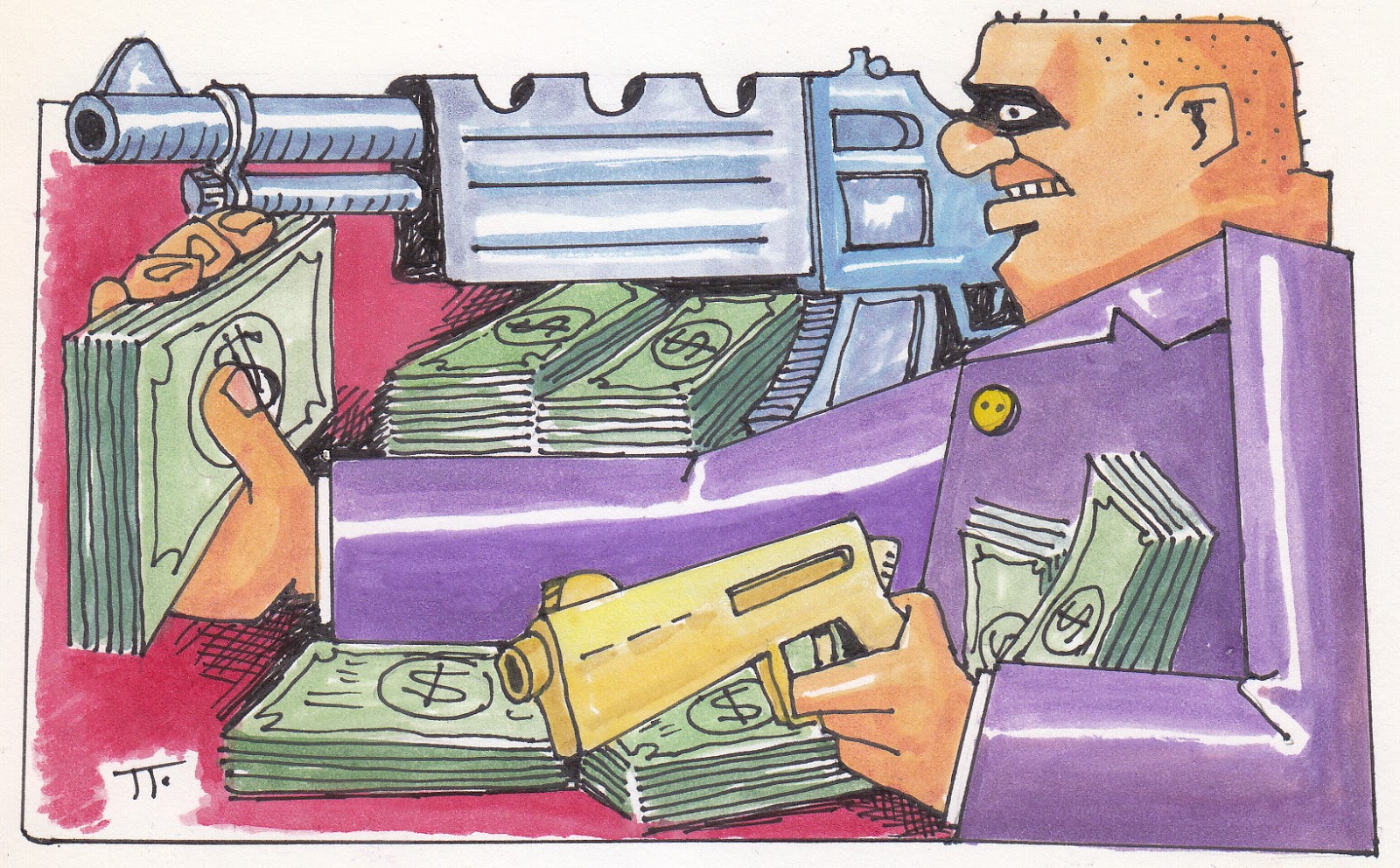
New Wave Mobsters
Mobsters
tend to evolve out of inner city poverty. The young look around and
notice the people in the neighborhood with flashy lifestyles, who
don't go hungry, who lord it over ordinary citizens. They resemble
the intimidating bullies in their own circles who ham-fistedly
appropriate their lunch money and humiliate them in other ways. The
limited options visible on their horizon tempt the young and some
inevitably are drawn into criminal apprenticeship.
Adult
gangsters of whatever ethnic persuasion traditionally provide
“protection” to small businesses, run numbers, hijack trucks, mug
citizens, commit armed robbery, murder for hire, burgle, organize
prostitution, trafficking, gambling, kidnapping, home invasions, drug
dealing and other illegal contraband and counterfeiting at all kinds
of levels. Eventually the most successful expand into legal
businesses, often as fronts for laundering illegal gains. They also
tend to spend time in prison, an extreme form of networking, where
they advance their education and
are further desensitized, distanced from any natural ability to
empathize they might possess. Like their counterparts chasing money
and power along legal corridors, they seem to become addicted,
seeking ever more profits, even after accumulating more wealth than
they can possibly spend, even considering their often extravagant
life styles.
The
United States has suffered various waves of criminal immigrants,
always a minority of any group but a significant one. Irish, Jewish,
Italian, Latino, Black, Chinese, Vietnamese... mobsters of all
stripes have variously dominated neighborhoods, cities, regions in an
ebb and flow paralleling periods of immigration. They sort themselves
out by the merging, warring or jittery co-existence. Of course there
are home-grown criminals also and rural bandits all over the world.
The white collar and political thieves, tycoons and corporate
malfeasors we will set aside for now except where they interact, as
underworld victims or collaborators. Robert Friedman, in his book Red
Mafiya,
comments, “The Russian Mafiya is
made up of multipurpose, entrepreneurial master criminals, flush with
billions in cash doing every shape, manner and form of global crime.”
When
in the 80s it became evident that the Soviet Union was falling apart
the leadership there met and concluded there were two possible
courses: a first strike nuclear attack on the U.S. (!) or, loot the
country. Gorbachev wanted to create a Scandinavian-type socialist
nation but he was soon got rid of, with U.S. support of course, and
the looting began. The enormity of the job soon became evident and
high-ranking government officials, KGB etc; turned for help to the
criminal element... which of course soon more or less took over,
conducting the largest exodus of national treasure in history. Russia
was in effect lawless so, to safely stache the spoils, accounts were
set up in the west. Though our civilization was fortunate the nuclear
option was foregone, this monumental theft has perilous repercussions
that will not be easily reversed. It is said that Putin consolidated
his power by selecting one of the oligarchs of this exodus, putting
them in a cage, on very public trial. The other oligarchs approached
Putin asking what it is he wanted. 50% was the answer. This deal made
him the wealthiest man on the planet, estimated at $ 200 billion.
Friedman is quite persuasive in his claim that dealing with Russia is
dealing with Mafiya.
A
U.S. center for the Russian mob is in the Brooklyn, New York
neighborhood of Brighton Beach, densely populated with Russian
immigrants. There criminals prey on small business and the local
citizenry. They enter into collaborative projects with already
existing gangs though their comfort with violence intimidates even
hardened veterans of the streets. This partially is accounted for by
the move Russian mobsters made to rid themselves of a particularly
psychopathic criminal named Ivankov, who they talked into “invading”
the U.S. Taking along a cadre of his most hardened lieutenants, he
soon took over the Brighton Beach neighborhood, ratcheting up
violence to a level the competition couldn't match. To him other
criminals were no different than small businesses – pay up or die.
Defy us? We'll murder your whole family. That's what works in Russia,
why wouldn't it work here? Brighton Beach police are out-gunned and
out-funded, if not corrupted themselves. One couple declining his
proposal to buy their antique shop, at a bargain basement price,
simply disappeared. Another couple, in Miami, accepted the
ridiculously meager buyout of their Deli and fled terrified to
Canada. The new owner had little interest in antiques or deli food
but an acute need for money laundering. Brighton Beach, Denver and
Miami, cities with dense Russian immigrants, were beach heads for
Ivankov's “invasion”. Like billionaires in general, these
criminals are not going to rest until they have it all. Israel's
policy of accepting Jews from Russia (or those who claim to
be Jewish) has affected the country severely. Officials estimate that
as much as 12% of their 500,000 Russian immigrants are criminals.
From Israel they have easy access to Western Europe, Canada and the
U.S.
Drug
running is a highly lucrative endeavor, usually thought of as the
domain of mobsters. But terrorists have realized drugs can be a means
to fund their operations. And states such as North Korea engage in
international criminality to supplement their annual budget, not to
mention gold bathroom fixtures. Another state not usually associated
with criminality, in fact usually seen as one of the more enlightened
states in terms of rule of law, not flawless of course but all is
relative: as one Russian gangster said, “I love the United States.
It is so easy to steal here.” And this is one of their safe havens
as far as safely banking ill-gotten proceeds. Friedman's description
of a Russian invasion of the U.S. by absolutely vicious criminals, is
disturbing enough at just the street crime level. Add to that their
branching out into sophisticated Wall Street, Banking and internet
cons, and the investigation of Russian meddling in U.S. elections, the
firing of FBI Director Comer, the apparent manuvoring to fire
investigative head Robert Meuller, and the knowledge that the modus
operandi of these criminals stops at nothing, freely and
imaginatively employing violence and extortion – luring victims
into situations where they are either hopelessly indebted or they and
their families are terrorized into corruption, or both. Israel's
government, Friedman claims, is the most compromised nation
by Mafiya outside
of Russia, that whether it can be considered a democracy (aside from
its suppression of Palestinians and theft of their land) is seriously
in question. When many of these mobsters own condos in Trump Tower
and rumors persist of ominous relations between the Trump
Administration and Russian figures, there is the danger that the time
is not far off where the same can be said of the United States.
I
draw on three books for these ruminations: Red Mafiya by
Robert Friedman; Organized
Crime by
Michael Lyman et al. (an actual text book); Angels,
Mobsters and Narco-Terrorists by
Antonio Nicaso et al.
Wednesday, June 21, 2017
Aftershock, Robert Reich, a review
In
his book, Aftershock, Robert Reich reviews features in our
society that undermine democracy – particularly concentrated
wealth. And the off-shoot, lobbyists in effect bribing
representatives and senators, vulnerable because they must
raise money for their ever more expensive campaigns. The successful
ones, when they leave office, with very nice self-voted retirement
benefits, often go to work for the lobbying firms or corporations
that previously had been lobbying them and for whom they, likely, had
sponsored legislation or other favors... or attached profitable
hidden amendments to bills. The average starting pay for retired
politicians who take the lobbying route is about $500,000. So
alluring is the game that even senators such as Richard Gephart, who
railed against oil baron and lobbyist corruption while running for
president in 1988, succumbed, heading up a lobbying firm with Goldman
Sachs as a client and chairing an organization that worked against
one of his previous pet issues, national health care.
Tax policy too favors the wealthy, thanks to this same corruption. George Bush I. expanded the amount one can inherit tax-free from one million to $3.5 million which obviously only serves the wealthy. Clinton extended the policy and Obama then generously allowed the wealthy to transfer $10 million to their children, tax free. All this means either equivalent cuts in services or increases on middle class taxes. The servicing of the wealthy by our politicians can hardly be completely hidden, though right wing radio and Faux News work mightily to obscure it, to blame the resulting malaise on immigrants, minorities the poor or some other soft target. Reich warns that this creates fertile ground for demagoguery (written before the rise of Trump, Reich's analysis goes some way toward explaining it).
But
the writer's main theme revolves around how the transfer of wealth
toward the 1% has reduced middle class consumption. After World War
II. until about 1975, a more equalitarian situation had evolved where
substantial numbers of ordinary citizens were able to earn a decent
living. This consumption drove the economy and that drive wavered as
greed-driven policies (see above) shipped jobs over seas, well-paid
with good benefits, good prospects for retirement, replacing them
with fewer and lower paying “service” jobs with little or no
benefits or security. Reich claims that the middle class responded
with three strategies to maintain their “lifestyle”: working
multiple jobs; spouses joining the work force; and credit card debt.
When there were no more extra hours to work in a week, for both
spouses, when the credit cards were maxed out, the piper fell due.
An
interesting story Reich relates to illustrate his theory brings up an
important figure in the Roosevelt Administration who I had never
heard of. Marriner Eccles chaired the Federal Reserve Board from 1934
to 1948. Eccles was a multi-millionaire tycoon whose fortune survived
the 1929 crash but not his faith in the established order. While
other members of the 1% took the position that nothing needed to be
done, viewing the market as self-correcting, Eccles arrived at a
different conclusion. He recognized that the rich have
disproportionate influence on government policies, pushing programs
that benefited them, not the more general population. He
basically came to the conclusion that middle class consumption was
essential to a healthy economy. He despaired of doing anything about
it though he did share his ideas by writing about them and testifying
before congress. This led to his hiring as adviser to the new
president and a year later, appointment to the Federal Reserve where
the idea of doing nothing to benefit the general population was set
aside in favor of what became Roosevelt's New Deal. Roosevelt was
reluctant to try Eccles' ideas but was persuaded. This laid the
foundation for the 1945 – 1975 period of prosperity, according to
Reich. These policies were bitterly opposed by conservatives at the
time and they awaited their moment to return to the pre-Roosevelt
philosophy which finally arrived when they hired the actor Ronald
Reagan to play the part of president.
Explaining
the voting behavior of the U.S. citizenry, as Reich does, by shifts
in the economy and erosion of consumptive power probably has some
validity but overlooks what Jane Mayer (in her book Dark Money),
Chomsky and others have pointed out: there is sophisticated and
deliberate manipulation by a powerful propaganda system, financed by
political activists among the 1%, figures like the Koch brothers,
Bradley foundation and others. They make full use of the
campaign-finance vulnerability of those seeking political office but
they go far beyond that. As Mayer has pointed out, for example, the
Kochs have created a political organization pushing their agenda
(basically a return to feudalism) that is larger, and better funded,
than the Republican Party.
Reich argues that when wealth is concentrated there is far less consumption driving the economy. So his complaint is not about fairness or justice, the more traditional left argument, but about the efficient workings of the economy. There is quite a bit to gloss over in this point of view. Reich does mention the inequities of class and racial bigotry, how an intentional transfer of wealth occurred starting, with a vengeance, as said above, at Reagan's ascendancy, and continuing steadily up to the 2008 crash. He points out that a television set made in Taiwan doesn't sell here for less than one made in the U.S. The greater profits made from cheaper labor go to the top and the loss, of course, goes to the bottom,... or middle. But he doesn't dwell there. So far as I can tell, he's right, hell, I remember!, that things were fairer, we (some of us) were better off during that post WW II. period. It could have been vastly improved and we should work to remake our society. But I see no recognition in his position of the fact that endless consumption is not environmentally sustainable, nor does it produce well-being. In the hierarchy of needs put forth by Abraham Maslow, who Reich acknowledges, once basic needs are met, more of the same does not satisfy. Reich's position is radical, in the context of our current 1% dominated political environment, but it is inadequate to address the crisis, not just of the malaise and anome of the victims of greed, but of the threat posed to our species, our civilization, perhaps life on earth, by the sinister trio of pollution, nuclear war and over-population.
What would a society look like that did adequately address the crisis facing humanity? I would venture that answering that question would involve this one: how can we create a society that provides food, clothing, shelter, education and health care for all world citizens in a way that does not trash the life system or crowd out other species? The complete answer is not on the tip of my tongue but it is something we best be about, and soon. The four years (minimum) that we are losing with the disastrous and discouraging Trump administration may bring us to or over the tipping point but as Bernie Sanders points out, our survival is too important, we do not have the RIGHT to give up now.
Monday, May 15, 2017
Culture of Terrorism, Noam Chomsky - a review
If
you believe, and wish to continue to believe, that the U.S. is a
force for democracy in the world, a nation with a free press and
vigorous debate on critical issues, this book is not for you. That
fantasy will stand if you accept the definition of democracy of those
who run the country, that is, an elite continuing to run things for
their benefit with the rest of us scrambling to survive, occasionally
ratifying their decisions by choosing from among the candidates they
supply for public office. The belief becomes fairy tale if you
question this story and insist that democracy means what the
dictionary says it means - “A government in which supreme power is
vested in the people and exercised by them directly or indirectly
through a system of representation.” Who is the extremist? Those
who promote the first definition or those who embrace the second?
There
is no doubt where Chomsky stands on this question and his book argues
on every page, with devastating effect, that the U.S. is an oligarchy
and one of the greatest purveyors of violence on the planet. He
argues that the 1%-owned media attempts to shape opinion, keeping
discussion within the bounds of “polite discourse”, carefully
avoiding the transgression of wandering outside the range embraced
among the elite, the only “people” that really count, unless you
include, of course, corporate persons... but that goes without saying
since it is the 1% who own the corporations.
The
author uses the 80s Iran-Contra scandal and U.S. policy in Central
America to elucidate this point of view, with by-the-way excursions
onto other terrain such as South Africa and Israel. There is hardly a
page without an incisive, finely crafted quote. In a paragraph
describing the real and repugnant intent and strategy of U.S. policy
toward Nicaragua, taken from official documents, differing perhaps
only in degree from what one might expect from a Mafia Don, Chomsky
goes on to explain why officials and media turn a blind eye: “But
to understand such matters, it is necessary to escape the confines of
the ideological system and to question the sanctity and nobility of
U.S. intentions. That is excluded, as an intolerable departure from
civilized norms.” And in describing U.S. violation of the Vietnam
peace agreement it had just signed in Paris: “The factual record
evidently lacks ideological serviceability so it has been replaced by
a mythical reconstruction crafted to satisfy doctrinal requirements.
Whatever the facts, the record must show that it is the Communist
enemy that cannot be trusted.”
Iran-Contra
Oliver
North is emblematic of that period under Reagan when, as Chomsky
says, a crack appeared in the establishment facade. The opening
though was quickly covered up, mildly embarrassing at worst, and soon
faded into history, along with the pardons. Chief investigator for
the committee? Thomas Polgar an active member of the Association of
Former Intelligence Officers. Chairing the committee? Senator Inouye,
who received extensive funding by PACs linked to the Israeli lobby.
Those not hypnotized by the charade could glimpse some interesting
items; careful avoidence of the Contra drug connection and Israel's
role in funneling arms to Iran and training and arming fascist forces
in Central America, a favor to Washington to get around congressional
restrictions. Chomsky points out that Nobel Laureate Elie Wiesel, the
much idolized symbol of compassion and peace, remained silent,
keeping I suppose to his mantra, “Speak no ill of Israel.”
Central
America and the Contras
Contra
drug smuggling, essentially creating the crack epidemic, as unmasked
by Gary Webb in his series for the San Jose Mercury News (but more or
less retracted when the editor/publishers couldn't stand the heat)
was another item partially exposed, but only for those willing to
look beyond the blinders of received wisdom. Reagan's terrorists, who
he called the moral equivalent
of our founding fathers,
were drug smuggling killers searching out “soft” targets in
Nicaragua and banking CIA largess. Of course it was the footsoldiers
doing the rampaging while the leadership did the lecture circuit and
hung out in San Francisco night spots.
During
the former dictator and U.S. ally (or puppet) Somoza's long reign,
whom the Sandinistas finally overthrew, one heard nary a peep in the
U.S. media, congress or administration on the brutality directed
toward and oppressive poverty of the average citizen of Nicaragua.
Everything was fine so long as U.S. corporate interests were being
served. But when a government came into power interested in
addressing the plight of the ordinary citizen, suddenly there was
great concern, and cries of Communism!
Marxist totalitarianism threatening our
very existence. Actually there is some truth in this latter claim.
Many of our “forefathers” practiced the abomination called
slavery. And if you translate “our” in that sentence into the 1%
then yes, there was reason to fear the threat of a good example... a
nation that served the needs of its people rather than U.S.
corporations and the wealthy might prove popular. Other countries
might get ideas were this “subversion” allowed to flourish. Even
people in the U.S. might get ideas. Too dangerous to tolerate. Thus
the U.S. sometimes installed and certainly supported unscrupulous
guardians, a tiny elite benefitting from their association with and
service to the Boss
in the north. In exchange for serious repression of any and all
questioning of that arrangement, military training and materials were
lavishly bestowed. Torture 101. Start a union? A Death squad visit
should discourage that. Discuss these questions in the press? Death
squad at the door. Knock knock.
Media
Complicity
An
insidious double-standard was applied consistently by U.S. mainstream
media in Central American reporting. Nicaragua had elections judged
fair by international observers, thus a democratically elected
government, the Sandinistas. Yet, Nicaragua was routinely referred to
as a Marxist dictatorship. Its “sins” were extremely minor in
comparison to the brutal oppression and death squad activism of El
Salvador and near genocide in Guatemala, these latter conditions
barely mentioned and their compliant governments generously, and
disingenuously, described as “fledging democracies.” Nicaragua
temporarily closed a newspaper which was openly supportive of the
terrorist attacks against teachers, postal workers and other “soft”
targets conducted by the Contras, invariably described as the
“democratic resistence”. U.S. media were outraged while ignoring
the chief means of censorship in U.S. partners-in-crime, El Salvador
and Guatemala, journalist homicide. In regard to the Iran/Contra
investigation, mainstream media took their cues from the committee,
venturing no where near the forbidden zones. Gary Webb was an
exception to prove the rule as he was drummed out of the profession,
an effective example to those tempted to wander, and to eventual
suicide (if it was suicide).
The
content of Culture of
Terrorism
is now history, replaced by current versions of a coopted democracy,
shaped, as always, to entrench the unfettered privilege of an elite.
Among that 1% is a range of opinion that traverses the political
terrain from moderate right to an ideology difficult to distinguish
from feudalism, this latter group now enthusiastically congregating
around the Trump administration, flirting with fascism. In some
psychological circles it is estimated that 4% of the male population
are sociopaths. They're not all particularly smart but those who are
can be assumed, given their advantage of ruthlessness, to rise to
positions where they can inflict upon the rest of us their
conscienceless narcissism.
Subscribe to:
Posts (Atom)