Thursday, July 21, 2011

Mystery

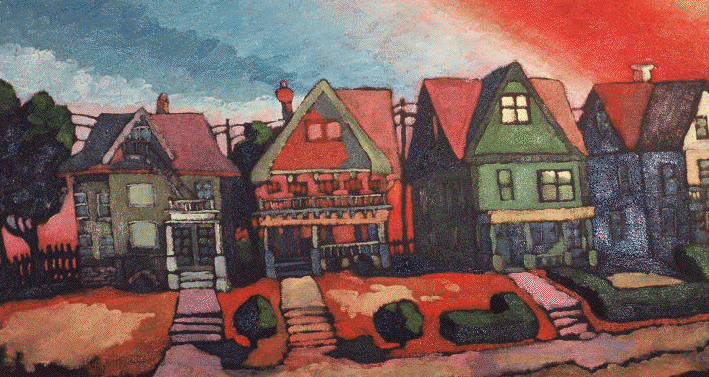
Humboldt Avenue, oil on canvas, 1970, Tom Ferguson

Imagine waking delighted to a place of astonishing beauty and vast complexity, of infinite micro and macro magnitude gifted with a cosmic capacity to replicate itself, slightly modified, every instant. This would be an impressive locale to visit and of course that is what we are doing, visiting here. Or it could be argued that we are not tourists at all but are intricately woven into a metaphoric tapestry of magnificent interconnection. Here is the root of polarization: the Visiting faction thinks it is separate, the Abiding faction feels interconnection.

The Visitor experiences frightening emotions and responds with safety-seeking behavior, attempting to accumulate a protective buffer of power, money, prestige… safety, for since s/he sees/thinks herself alien s/he sees/thinks himself vulnerable. In a word, identifying with the separate entity s/he conceptualizes her/himself to be that entity is subject to slings and arrows, the nets of chance. Since no amount of safety will ever be enough in a world of relentless change, an obsession develops which precludes noticing the world as described in the first sentence above, except in odd unguarded moments, facilitated by alcohol et al, or perhaps art.

One could look at the Abiding faction as the advanced guard of an awakening, one anticipated intuitively by historical figures of religion, philosophy and art. An awakening whose trajectory hopefully intersects such that their (our) frantic destructive behavior over these millennia will survive only in the embarrassed annals of an infant species, while the awakening one blossoms into full consciousness and the harmony native to that state - justice, empathy and environmental balance.

Thursday, July 14, 2011

The Most Dangerous Moment in History


During the Cuban Missile Crisis U.S. destroyers attacked a Russian submarine. The submarine was given orders to launch its nuclear warheads against the U.S. This would have certainly precipitated a full retaliatory exchange and we would most likely not be here to discuss it. The submarine commander refused the order. I had never heard this story until I read it in one of Noam Chomsky’s articles. Though civilization was spared, the mind-set that brought us to that moment is alive and well. That mind-set is the subject of most of Chomsky’s books.

Interventions is a collection of short essays aimed at a broad readership, commissioned by the New York Times Syndicate after Noam Chomsky’s 2001 best seller 9 – 11. One of the author’s central claims is that the mainstream media confines debate to a narrow status quo, roughly Hysterical Right to Middle Conservative with few exceptions. As if to confirm Chomsky’s thesis the syndicate distributed the essays abroad but nary a one found its way into the U.S., neither in the New York Times, Washington Post, L.A. Times etc;

Iraq is the primary topic, not surprising given the essays were written during what Chomsky calls a criminal invasion. He exposes administration lies about WMD, Al Queda/Saddam ties and involvement in 911, deconstructing U.S. claims to be promoting democracy - it being true when you take into account that in their minds democracy = plutocracy, being demonstrably false when you use a non-Orwellian definition. One example: polls showed that 90% of Turks opposed allowing the U.S. to invade Iraq through Turkey. The administration ferociously berated the Turkish military and government for following the wishes of the people.

Chomsky lays out an analysis of what’s going on that stands the mainstream propaganda machine on its head. U.S. intentions in Iraq are to set up a permanent military base in the center of the richest oil reserves area on the planet. Israel is a U.S. aircraft carrier maintained to aid the imperial quest (in return Israel gets the U.S. veto at the U.N.). U.S. policy toward Serbia/Kosovo and Cuba (well, the world really) is to vigorously discourage independence from U.S. centered Corporate rule or as they like to call it, the “free market”. In the history of this movement it came very close to triumph but was thwarted, partially and only temporarily by the election of Theodore Roosevelt. Laboring mightily since that defeat they now sense victory and are straining at the fetters of democracy, yearning to throw off at long last and forever that notion of equality that stands in the way of their absolute superiority.

Wednesday, July 6, 2011

Pickpockets at PSC


This is my public comment made 7/6/11 to the GA. Public Service Commission on the occasion of their consideration of Georgia Power's request for yet another raid on the public treasury in the form of rate hikes to cover anticipated cost over-runs for their nuclear fantasies. They already were granted rate hikes to cover building the new reactors and an additional amount to cover the loss in credit ratings due to pursuing dangerous nuclear technology. You have to hand it to them, they've got gall.

Mulling over what to say for this meeting it occurred to me that the creators of this Commission did not choose GPC - Georgia Power Commission. Words have meaning so I was happy to notice what PSC stands for until I remembered George Orwell and how political bodies sometimes engage a practice that has come to be dubbed Orwellian.

Barbara Tuchman, in her book The March of Folly, defines folly as acting against one’s own self-interest. The business and government officials who decided to build sixty nuclear plants on an earth-quake fault don’t necessarily fit the definition. By now those leaders are probably living on nice pensions far from Fukushima so their personal interests could be said to have been served. But I think we would have to conclude that Orwell had been at work, that Public Service was really not what they were about.

Which brings me to argue that the public is not served by granting profit-seeking companies pickpocket access to the public treasury. It is even less served when those companies pursue the folly of dangerous nuclear power. I hope it doesn’t require any more Fukushimas for us to realize that when the nuclear industry chants its mantra of “safe and clean” it is committing high Orwellian-speak. Nuclear technology is expensive, risky, cumbersome, polluting and yes, dangerous. It is time to give serious consideration to NOT dangerous alternatives, which are showing themselves more competitive and benign with each passing year. I speak of Solar, Wind and Conservation.

In this new climate - I would say post-Fukushima but that disaster still bubbles ominously to our west – I refer you to the website of the Institute for Energy and Environmental Research, IEER.org where you can download their Roadmap for a U.S. Energy Future, a roadmap that persuasively excludes coal and nuclear, both proven truly dangerous to the health of life on this planet. When you enable an alcoholic you do neither the addict nor the public a service.

As a post script I would like to add that Germany, Switzerland and Italy have all recently made the sensible commitment to eliminating nuclear power, turning to alternatives, in which they already are far ahead of the U.S. And as we speak two nuclear reactors in Nebraska are threatened by flooding, a not unpredictable event given that reactors must be located near and are dependent on large volumes of water.

Monday, June 27, 2011

Commonist Nostalgia


Michael Parenti’s book Superpatriotism is an excellent deconstruction of “free market” ideology. He claims that the people of Eastern Europe and Russia had guaranteed jobs, health care, housing, education etc; With the fall of the USSR they entertained visions of suburban McMansion, two car garage etc; but what they got is shit and corruption: gangsters running things in collaboration with dictators, no real political input, more or less fake elections like here, malnutrition, no work, no food, no suburbia.... they become third world… and they wish they had back what they had before the fall. They aren’t idealizing it, they definitely lacked political freedom, due process etc; but they had the basics and the basics are pretty important – try going without’em. The comparison isn't of "freedom and tyranny but of having the basics and of not.

Noam Chomsky has also pointed out, in his curtain-lifting books, that in the Soviet domains of Cold War days the people had the bare necessities - even high government officials lived in modest apartments - whereas in the U.S. domains, Central and South America, Indonesia, etc; a tiny wealthy elite were maintained (so long as they served U.S. corporate interests) while the majority population endured deprivation, malnutrition, poverty and were threatened by accusations of "Communist!", which made them targets of death squads, if they tried to organize to improve their lot. The U.S. provided much of the means for this oppression via “foreign aid”, CIA intervention, military training and arms – funded by U.S. taxpayers of course. So the bottom people of an affluent nation fund the oppression of bottomers of another nation. As the observation goes, the wealth is created by the workers and divided among the owners. The owners own/control the media so we get ministers of misinformation like Rush Limbo, O’reilly etc; keeping us distracted from the exquisite scam by demonizing immigrants, Islam, the homeless, dark-skinned people, gays, women… whatever works. This history is shameless and disturbing enough but as the logic of the elite notion of globalization plays out our capacity to rationalize injustice will be challenged as it encroaches upon our personal space.

Thursday, June 23, 2011

Fear of Sharing


Just finished The Big Rich by Bryan Burrough. One of the things that struck me about the Texas oil-millionaires, aside from their often ostentatious and outrageous consumption, was that many, despite immense wealth freeing them from the necessity to work for a living, continued to go into the office six days a week like any other working stiff. Roy Cullen even drove a cheap Chevrolet and brown bagged his lunch. Since they were basically workaholics, why were they so concerned about “big spending liberals” taxing them to death? They could have simply paid the tax owed, say 40% or whatever it was, and still had way more than they knew what to do with. They certainly weren’t working for their salaries, struggling to meet the mortgage, pay the bills.

Unfortunately these very wealthy individuals were mostly extremist conservatives who shifted the country rightward with their undemocratic money influence. Cullen even seriously argued for the idea of one dollar one vote. They funded McCarthy, William F. Buckley, John Birch Society, KKK etc; right wing radio and newspapers and supported politicians who would do their bidding and went after those who wouldn’t with Swiftboat type campaigns, funding their opponents, and not just in Texas. They funded the Contra terrorists in Nicaragua, fully buying into the hysterical religion of anti-communism. Of course not every oil millionaire fits the profile. Some became world-class partiers, some collected art and enjoyed high culture, donated to worthy causes. Cullen, again, gave away over 90% of his fortune to hospitals and universities while otherwise completely embracing the right wing stereotype.

This kind of concentrated wealth has repercussions. When workaholics are out there feeding their addiction and are willing to use their influence to grease government wheels in order to pull off deals that include harmful environmental and social costs then we all lose, enabling a dysfunctional class. Cullen’s one dollar one vote philosophy isn’t that far off as embodied in our political system where politicians must raise huge sums to finance their campaigns. As Molly Ivins, a Texan of a different stripe, used to say, “You dance with who brung ya.” If the public finances elections then it is the public who brung the politicians so it is the public, not the corporations and wealthy class, who they owe, who they represent. The health care debate, military spending, corporate tax policy, the whole range of issues would be a whole different discussion under those circumstances. That class would still own the media and thus limit if not control debate but there might be something we could do about that too.

Tuesday, June 14, 2011

Nuclear Power After Fukushima


Journalist Stephanie Cooke was at the Carter Center June 7 to promote her book, In Mortal Hands, a Cautionary History of the Nuclear Age. Her talk emphasized the Fukushima disaster and drew from history to support her anti-nuke view. The industry, for example, consistently underplays accidents, waiting until things have cooled off, when people have lost interest, assumed it’s all over, on to other things, when they finally admit the true figures of radiation releases, extent of damage etc; Even then they hedge with comforting denials of long-term effects, in language that may be technically correct but misleading. This could describe precisely corporate/government PR strategy around the BP oil spill, the Valdez disaster, Katrina, Chernobyl, conditions for cleanup crews at ground zero…. doesn’t seem to matter, those invested in the irresponsible continue to claim, and may even believe, that it’s all safe, under control, no problem. If belief, it’s belief of convenience. When your livelihood depends on believing something chances are you will talk yourself into it. Or at least you will keep your mouth shut. Due to this delay strategy fewer citizens are aware that three of the Fukushima reactors experienced full melt-down and that high levels of radiation are contaminating land and sea. The situation is an on-going catastrophe which, hopefully can be contained. Cooke informs us that contamination from this accident will be around for the rest of our lives. How many of these assaults can our life system withstand, do ya think?

Ms. Cooke was interviewed on nation-wide radio within hours of the Fukushima accident. The show also had a pro-nuker who assured listeners that the accident was low severity, it would all pass, a minor situation etc; Locally a Georgia Tech Professor did the same. The Japanese utility, TEPCO, several years before the current accident, was caught falsifying data (confirming that utilities tend to view safety as a public relations problem). The CEO was fired/resigned but shortly after hired as a high-paid “advisor” in the same company. Cooke claims that the Japanese squelched opposition to nuclear plants by creating a tax, which was showered on those who lived in the rural areas selected for plant location. The U.S. encouraged nuclear development in Japan, as in other nations, as part of its Peaceful Atoms project, which really amounted to a propaganda campaign behind which nuclear weapons could be pursued. The sad truth is that whatever nuclear proponents might claim in the “safe and clean” department, their real project is a major raid on the U.S. treasury and utility ratepayers with the macho side-benefit of Weapons of Mass Destruction. They make the Mafia seem like stumbling amateurs.

Friday, June 3, 2011

Energy Roadmap


Carbon-Free and Nuclear-Free, a Roadmap for U.S. Energy Policy

The Institute for Energy and Environmental Research (IEER) offers the book as a free download on its website (www.ieer.org). It is a product of IEER and the Nuclear Policy Research Institute. Its author, Dr. Arjun Makhijani, had to be talked into doing the book by S. David Freeman and Dr. Helen Caldicott. He had been so pre-occupied with research on the environmental and health affects of nuclear testing and processing that he was unaware of the advances in technology that had occurred during those years. Thus his skepticism and reluctance were jettisoned by the virtual revolution he discovered when he finally agreed to take on the research.

The book addresses the crisis represented by severe climate disruption, oil insecurity and nuclear proliferation. Makhijani set out to answer the question: is it possible to eliminate CO2 emissions from the U.S. energy sector without resort to nuclear power, without purchasing off-sets and at reasonable cost? His book answers in the affirmative, and provides a roadmap to get us there in 30 to 50 years.

The prime alternatives in Arjun’s scenario are wind and solar, augmented by hydropower, compressed air and back-up natural gas. Developments in hybrids and batteries make feasible a situation where parked cars could either feed or draw from the grid as needed.
U.S. electrical consumption could be more than met by wind generation in 12 Midwestern and Rocky Mountain states. Just the parking lots and rooftops in the U.S. could provide, via solar installations, most U.S. electricity needs. The Roadmap could be created with existing technology, requiring no miracle break-through, although of course developments in all areas would only shorten the timeline and/or reduce cost.

The political will to pursue this roadmap of course is the rub. Entrenched interests have the ear of policy makers. For example, a Blue Ribbon commission was appointed by the President to study the future of nukes in the U.S. Neither Dave Freeman, Dr. Caldicott or Makhijani were invited despite their knowledge and credentials, presumably because their opposition to nuclear power might skewer the pro-nuke conclusions presumably wished for, presumably due to ideology and industry campaign contributions. It has always been thus, folly will triumph unless its only effective adversary, an informed democracy, is mobilized.